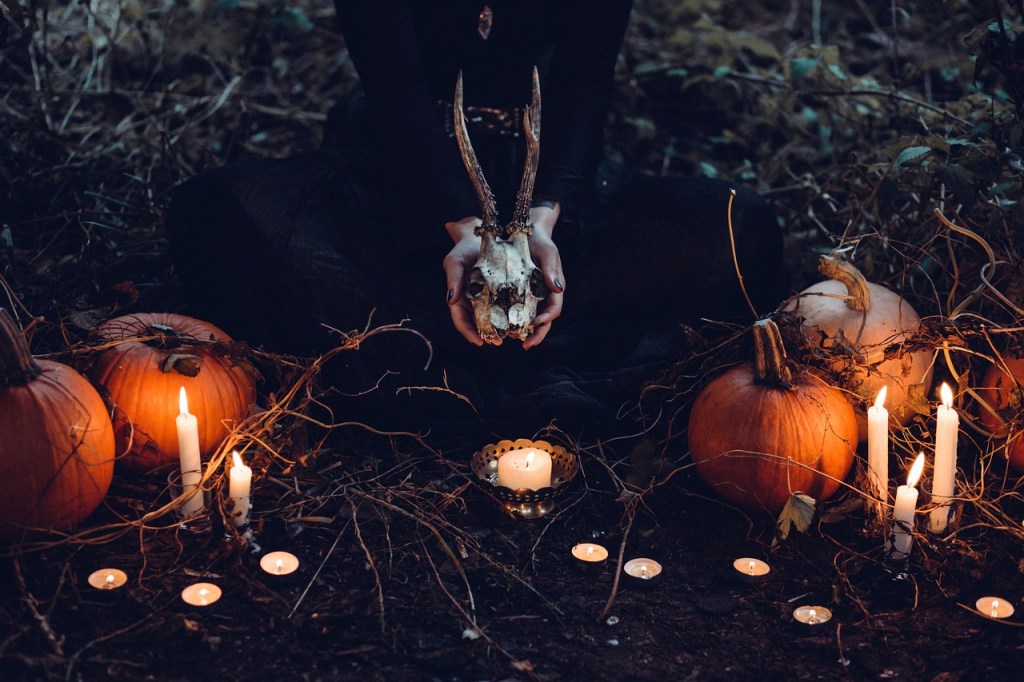
I have always loved Halloween. As a kid, I rarely did normal, pre-made costumes, instead enlisting my mother to make me a Lego block, peacock, wood duck, or any other number of assorted animals or weird things. Even though we lived in the country and I didn’t get to go trick-or-treating very often, I was obsessed with black cats and pumpkins. Some of it was because I love fall. The cooler temperatures, the artist’s palette of colors that the leaves become, everything is amazing about it to me. So having a holiday like Halloween, where I can let my creativity and love of the spooky run rampant, is a perfect fit.
Recently, I started getting interested in the roots of Halloween. Of course I know the Halloween of now, with costumes and trick-or-treating and haunted houses. But the roots? While I vaguely knew some of it, words like Samhain and All Hallows Eve, I was always a little perplexed how it all came to be. So, I decided that to kick off the spooky season I was going to do a bunch of themed blogs about my favorite holiday. What better way to start that off than with getting a brief understanding of where it all came from.
Like all history, it’s hard to get a complete picture in a short time. There could be hundreds, even thousands of years of history that you need to wade through. There’s inaccurate records, and dealing with references written hundreds of years later by people in other cultures. All the cultural and geographical contexts that come into play, how an idea changes and shifts and evolves as time progresses. All of the influences and nuances. Even something as simple as Halloween, I quickly found out, has enough rabbit trails and references to fill a book. So, how was I going to fit this into a blog?
So, I decided to show you a little of how my brain works when I’m curious about something. It all starts with questions.
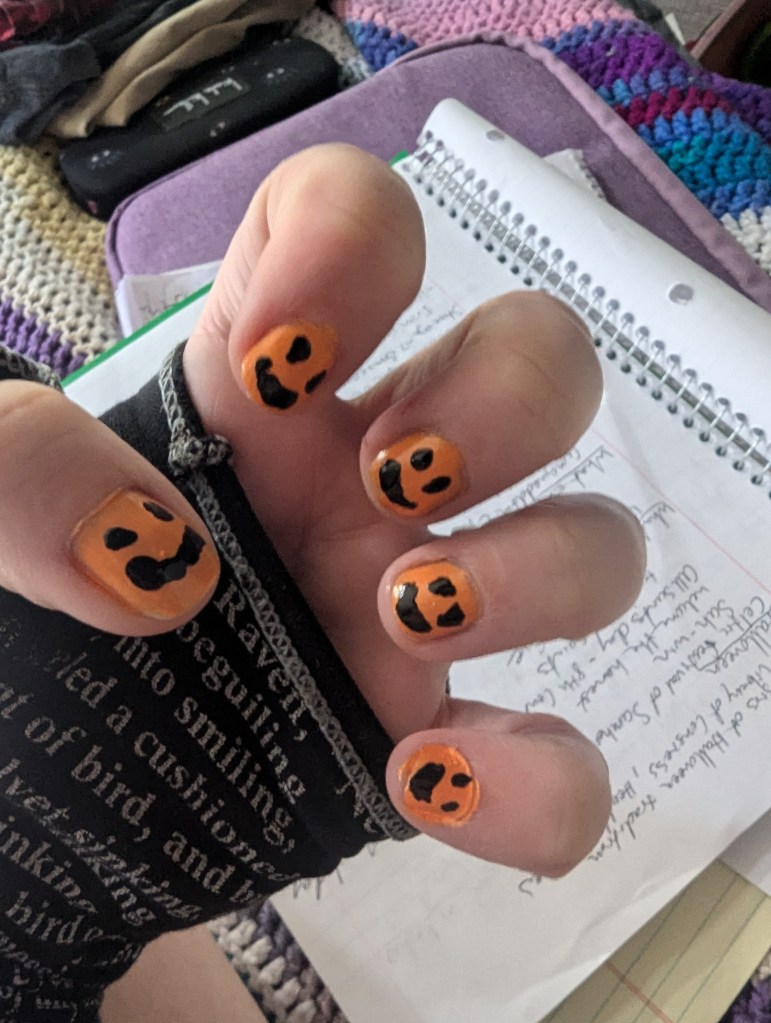
What are the roots of Halloween?
Like most things, our story starts in the time of history before written record. Specifically, in central Europe with a group of people that we have come to collectively call the Celts, or Celtic people. Its roots lie in one of their festivals called Samhain (pronounced Sow-win, not Sam-hane like I always thought).
Samhain was an autumn festival. According to irishmyths.com, it was held at the end of October and marked the end of the pastoral year. Samhain can possibly translate to “Summer’s end” or “Assembly”, both making sense as for the time of year it occurred and that it brought the community together in a great celebration. Samhain was also a time they believed the veil between our world and the world of the dead to be thinnest, allowing all manner of things to come over to our world.
I love that Halloween starts here, because I consider myself a Celtic person ancestrally. While I don’t draw heritage from any one culture, my ancestry pulls from Irish, Scottish, English, Norway, German and Dutch. Definitely within the Celtic realms.
But this got me to thinking…
Who are the Celtic people?
I thought I had a relatively decent idea of who the Celtic people were. So, imagine my surprise when I discovered they weren’t anything like I thought. But that’s what I love about learning new knowledge. You take what you think you know, and sometimes you confirm it, and sometimes you find things that flip it on its head.
Like how I thought the Celtic people were all one people. Or were mainly in Scotland/Ireland. I knew that their religious people were called Druids, and that there religious ceremonies were very tuned to the Earth and the celestial movements of the sun and solstices. I also know that they often were in conflict with other cultures, namely the Romans.
When I started digging in I realized that the Celts will have to be another blog all on its own, and probably several because the history and culture of the true Celtic people seems to be incredibly rich and varied. Most surprisingly, it was a lot more expansive than I thought it was.
Type in “Celt” in a search engine and you come back with a large and expansive record. It doesn’t take long to realize that there is a lot about the Celts that is very controversial and argued about, which is why someday I want to do a blog or two just on the different controversies. But I tried to limit this to a quick overview of the things that people agreed on.
First, the ‘Celtic’ people were actually a collection of varied tribes that stretched all over most of Europe from the 2nd millennium to the first century BCE. At some point, they stretched to the Northern isles of Great Britain (England/Scotland) and Ireland (although whether that was an invasion or simply an expansion of their culture to the islands experts can’t seem to agree) (Amgueddafa Cymru, Brittanica.com). There are a ton of names for the different tribes, including the Galatai, which was the Greek word for the Celts possibly derived from the region they inhabited. There were four tribes in Wales alone: the Ordovices, the Deceangli, the Demetae and the Silures (Amgueddafa Cymru). There is evidence of trade with some of the european tribes and the Greeks, such as in Hallstatt, Austria, as early as 700 BCE (Brittanica.com). Or the La Téne culture that inhabited the Rhine area of Germany and France (ancient-origins.net).
Second, calling them ‘Celtic’ is more of a modern word to describe these varied tribes. Experts aren’t entirely sure what they may have called themselves, as there aren’t any written records from the tribes themselves (they either had no written language or none that has survived for archeologists to find), so most of our knowledge comes from the other cultures they came in contact with, like the Greeks and Romans. The Greeks called them Keltai, Keltoi or Galatai, while the Romans called them Celti, Celtae, or Galli (Amgueddfa Cymru). What was interesting was that when I tried to find translations for these words, I couldn’t really find a translation. I did find a reference in Wikipedia that says some linguists believe that these words were borrowed from the Celtic tribes and their language, meaning that while we may never know for sure, it could be that they actually did call themselves some version of Celt.
As far as religion, again I encountered a very rich and varied assortment of possibilities (which makes sense considering how widespread the Celtic people were). Most sources agreed that the Celts were very close to nature and very attuned to the celestial movements of the sun, centering their feasts and celebrations on important dates like the solstices and equinoxes, using them to mark their planting and harvest. The Druids were their priests, although we don’t know much about them.
As with many cultures, the Celtic tribes came into conflict with others, namely the Romans (although from what I read at least some was a mutual conflict). The Celts were pushed out of central Europe, finding refuge in Ireland and Scotland (Britannica.com). Again, this is super-simplified and I hope to do some more blog posts on this in the future.
So, Back to Samhain. . .
While there are apparently many Celtic festivals and important days, Samhain was an important day. It mirrored Beltain in the spring as a time when the earth changed. For Samhain, it marked the end of summer, and was seen as the time when the veil between the worlds was thinned and the dead could walk the earth. Beltain, on the other hand, was the awakening of Spring, when the veil thickened and the light beat back the darkness (druidry.org, irishmyths.com). While it may seem odd that light and dark were so powerful in our modern world of electricity, it helps to think back to a life without this invention. Where dark and light, the hours of the day, the warmth of the sun might mean the difference between your own life and death. It is easy to understand, in a society that is so closely tied to the Earth, how festivals would arise to honor the spirits and pray. It is not to differently to our modern world, where we pray in times of darkness and trouble.
I found several references to the celebrations that occurred on either Samhain or Samhain Eve, although the sources could not agree on a date for Samhain, either being October 31st or Nov 1st for the actual date of Samhain. I wonder if this is because of the difficulty of placing the Roman calendar upon the celestial clock, and if the Celts were working more off of a sun placement than any particular day, so that placing a firm date on it today is quite difficult. I found reference to a dumb supper performed on Samhain eve, in where a family set an extra setting for a dead ancestor, and were not allowed to look at the dead otherwise bad luck would fall upon you (druidry.org). Other sources talked about animal sacrifices in a huge bonfire, pieces of the fire then being taken home to each person’s hearth in order to grant them good health and luck during the dark winter (irishmyths.com, History for Weirdos). In Ireland, we even see what might have been the origins of the jack-o-lantern. It is said that these pieces of the bonfire were taken home in hollowed out turnips (pumpkins being native to the Americas). There is also the story of Stingy Jack, who was rejected by both the Devil and Heaven, and the Devil fashioned him a lantern of an ember in a skull and sentenced him to wander the earth for eternity. There are also tribes that might have placed the embers in skulls and then hung them from trees to ward off evil spirits (History for Weirdos, irishmyths.com).
Like many other Celtic religious ceremonies, Christianity borrowed much from it when they came in contact. Whether it was an attempt to co-opt the religion, simply a natural merging of the cultures, or an outright destruction of the Celts in Christianities “our god is the only god’ way, there are many different theories. But in the 8th century, Pope Gregory III named November 1 All Saint’s Day, the day to honor saints. The day before came to be known as All Hallow’s Eve (Thomas, Brittanica.com).
What is a saint?
This one was a pretty easy find. The U.S. Conference of Catholic Bishops states a saint “is a person who lived heroically virtues lives”. They “offered their lives for others, or were martyred for their faith and who are worthy of imitation”.
What is Hallowmas, All Saint’s Day and All Soul’s Day?
It was actually hard to find information on Hallowmass, or All Saint’s Day Eve (Oct 31). I finally found an article from the Vatican News, calling Hallowmas the Vigil of All Saint’s Day “when Catholics remember those who have gone before us to enter our heavenly home”. There were many more sources for All Saint’s Day, which like you would think, is a day to honor the saints who have come before whether the church had ordained them or not (Nov 1). All Soul’s Day occurred on Nov 2 and was a day to honor and pray for those still in Purgatory on their way to Heaven (Wells, Brittanica.com).
In conclusion. . .
Or should I say, the end our brief, brief dive into the origins of Halloween. Because like I said, I could fill a book with all the rabbit trails I found (and maybe I will someday), and I know I just barely scratched the surface. If anything, this brief dive has invigorated and energized my love for Halloween. I had to end the blog somewhere, or this wouldn’t have come out until long after Halloween had come and gone.
I hope it wetted your appetite, just like mine, to learn more about Halloween. From the Celtic roots of traditions that still go on today, to the entrance of other religions and cultures. Many more cultures and religions had similar days honoring the dead, a theme that riots across the Earth, driven by our roots as societies that were closely tied to the Earth and the passage of the sun and seasons. But don’t just take my word for it, go exploring for yourself.
Until next time, Wonderers!
Sources:
Who were the Celts?, Amgueddfa Cymru museum, retrieved from https://museum.wales/articles/1341/Who-were-the-Celts/
The origins of Halloween Tradition, Thomas, Heather; Library of Congress retrieved from https://blogs.loc.gov/headlinesandheroes/2021/10/the-origins-of-halloween-traditions/
What is Samhain?, Irishmyths.com retrieved from https://irishmyths.com/2022/08/11/samhain/
Celt, Brittanica.com retrieved from https://www.britannica.com/topic/Celt-people
All Saint’s Day, Brittanica.com retrieved from https://www.britannica.com/topic/All-Saints-Day
Samhain, Druidry.org retrieved from https://druidry.org/druid-way/teaching-and-practice/druid-festivals/samhain-festival
All Saint’s Day, Catholic Online retrieved from https://www.catholic.org/saints/allsaints/
The Catholic Roots of Halloween, the Vigil of All Saint’s Day; Wells, Christopher; Vatican news retrieved from https://www.vaticannews.va/en/church/news/2019-10/the-catholic-roots-of-halloween-the-vigil-of-all-saints-day.html
How the Great La Téne Culture Changed Iron Age Europe, Ancient-origins.net retrieved from https://www.ancient-origins.net/history-famous-people/la-tene-culture-0016032
Episode 107: The History of Samhain, History of Weirdos podcast
 The Modern Wonderer
Leave a comment